
What do you do when you hear a sermon and you know, deep down in your soul, that what you’re hearing is wrong? When the Holy Spirit as that still, small voice is whispering so loudly that you can almost hear his voice physically saying, “This is not Biblical!”? Do you get up and slip out, maybe not go back to that church again, or stay because it’s rude to get up and leave? And as Christians do we have an obligation to “examine the scriptures to see if these things [are] so” as the Bereans did in Acts 17:11? Should we blindly accept any and all teaching, or are we to sift each teaching through the scriptures?
A couple of weeks ago, I sat through a sermon like this and it was all I could do to stay in the pew. Everything in me was screaming, “You have to get up and leave. This is NOT the word of God!” But I didn’t leave; I stayed and squirmed like a four-year-old.

“Beware of false prophets, who come to you in sheep’s clothing but inwardly are ravenous wolves. You will recognize them by their fruits. Are grapes gathered from thornbushes, or figs from thistles? So, every healthy tree bears good fruit, but the diseased tree bears bad fruit. A healthy tree cannot bear bad fruit, nor can a diseased tree bear good fruit. Every tree that does not bear good fruit is cut down and thrown into the fire. Thus you will recognize them by their fruits.” (Matthew 7:15-20 ESV)


The fruit from this sermon from is an example of bad fruit. It looks fine on the outside, but it is rotten inside its core. The message wrapped the flagrant perversion of the word of God within a “good” message. The text was Matthew 13: 44-52 (ESV):
[Jesus said] “The kingdom of heaven is like treasure hidden in a field, which a man found and covered up. Then in his joy he goes and sells all that he has and buys that field. Again, the kingdom of heaven is like a a merchant in search of fine pearls, who, on finding one pearl of great value, went and sold all that he had and bought it. Again, the kingdom of heaven is alike a net that was thrown into the sea and gathered fish of every kind. When it was full, men drew it ashore and sat down and sorted the good into containers but threw away the bad. So it will be at the end of the age. The angels will come out and separate the evil from the righteous and throw them into the fiery furnace. In that place there will be weeping and gnashing of teeth. Have you understood all these things?” They said to him, ‘Yes.’ And he said to them, “Therefore every scribe who has been trained for the kingdom of heaven is like a master of a house, who brings out of his treasure what is new and what is old.”
Below are the sermon notes that were included in the bulletin for the day’s service. Click on each image to see a larger view:
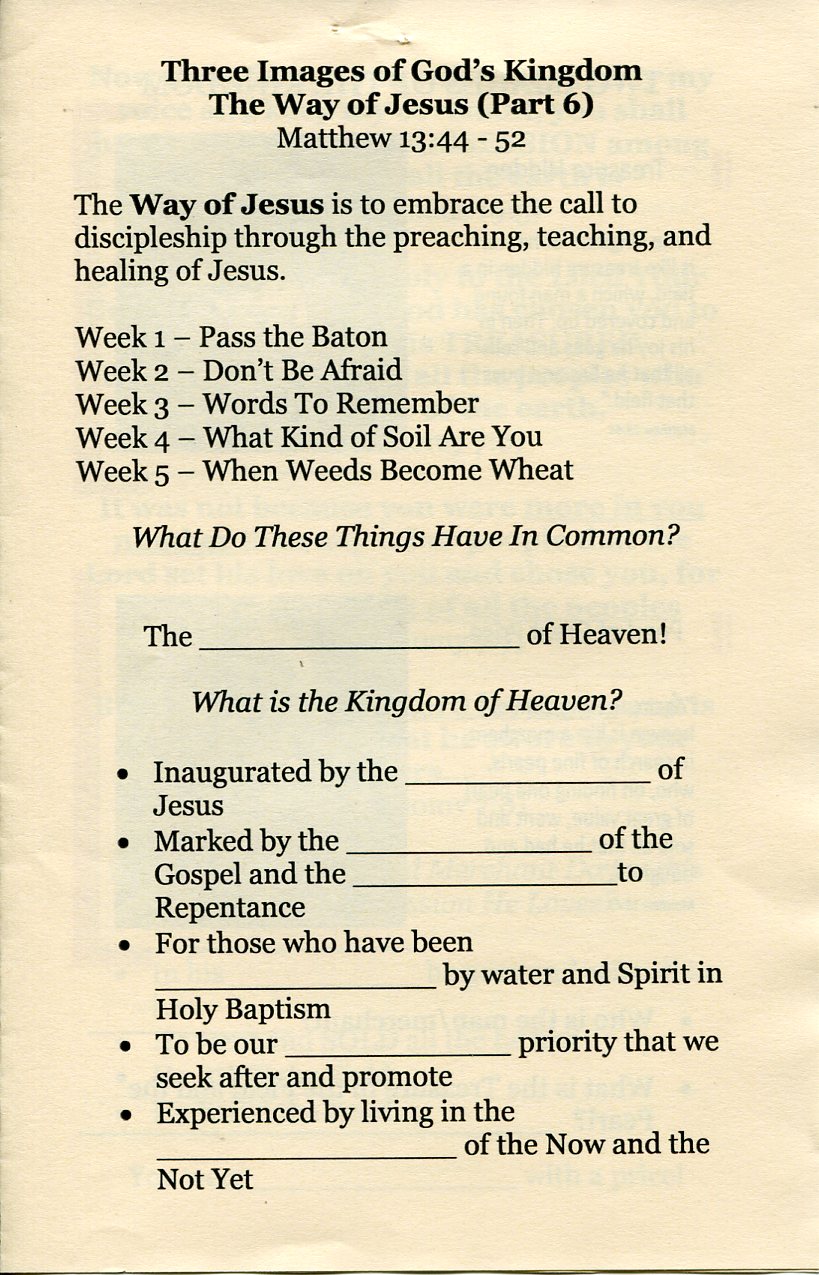

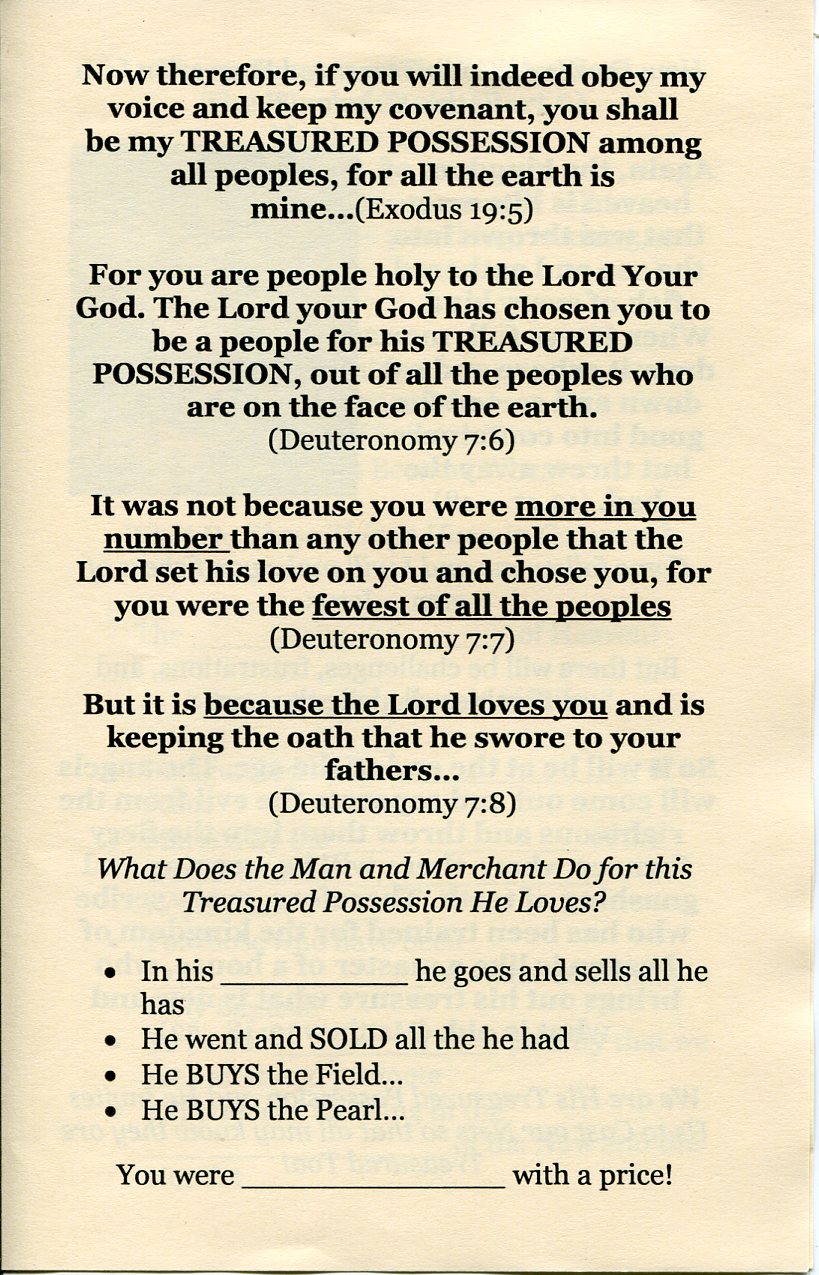
The message is solid at first, as the pastor discusses the kingdom of heaven on the first page, with the blanks filling in this way:
The Kingdom of Heaven is:
- Inaugurated by the coming of Jesus
- Marked by the preaching of the Gospel and the call to repentance
- For those who have been born again by water and the Spirit in Holy Baptism
- To be our first priority that we seek after and promote
- Experienced by living in the tension of the Now and the Not Yet (ie, God’s kingdom is here because of Jesus, but it is not fully realized as we await him coming again)
These are good doctrine, although one’s theological understanding of baptism may differ from the Lutheran perspective, and we are to live as though the kingdom of God is close at hand. He goes on to read the parables, but then he turns millennia of Christian understanding and exposition on these three parables inside out. And he doesn’t even try to disguise it; he comes right out and proudly tells us up front that he’s teaching something completely different.
Here’s how he begins his exposition on the text (with emphasis placed to match his):
“Now when you first read these, you kinda wonder is this about me? Is it about us? Are we the man? Are we the merchant? Are we the ones who find something buried, valuable, and treasured, and we go out and sell everything for it; we give up everything for it and that’s kinda how the Church usually read it for a long time. But I want to suggest to you something different this morning; that the man and the merchant, that the one who finds the buried treasure, the one who seeks after the pearl of great price is none other than Jesus himself. He is the one who is seeking; he is the one who is finding; he is the one who is going after that which is buried, that which is treasured, that which is valuable.
“In fact, if you think about it, this is what Jesus does. If Jesus is the man and the merchant, then the treasure in the field and the pearl is none other than us, the people of God. WE are what is valuable. WE are what is worthy of everything being sold for. WE are a TREASURE that God desires…”
He turned the parables upside down and inside out. Instead of teaching that the glory of God and his kingdom are worth everything we have or own or think that we want, he has made us the focus, like we are to be worshiped by God instead of the other way around. Who was the first to twist the words of God? Satan, as the serpent, misquotes God in questioning Eve in Genesis 3:1,4-5 (ESV):
“Did God actually say, ‘You shall not eat of any tree in the garden?…You will not surely die. For God knows that when you eat of it your eyes will be opened, and you will be like God, knowing good and evil.”
Satan knew full well that God had not told them they couldn’t eat of any tree at all, just a specific one. He sowed doubt, which led to temptation, which led to sin, which led to destruction. How is it different for a pastor to twist a parable of Jesus away from its original meaning to change the focus from the glory of the kingdom of heaven onto an egotistical and prideful self? “Did God actually say that the kingdom of heaven is like a treasure hidden in a field and that you should sell everything you own to buy that field? You will not surely die. God knows that YOU are the real treasure, and he’s willing to sell everything he has just to possess you.”
In the video below are excerpts from the sermon; I begin this video at the point where I quoted the pastor above, and I’ve edited out antcedotes unrelated to the text (there’a a link to the full sermon at the bottom of this post): https://youtu.be/kKVoogwUNn0
He gives us a lot of exposition on the people of God being the treasured possession of God from the Old Testament, and since we, as Gentile Christians, are adopted into the family of God and have been grafted into the Vine, yes, we are the people of God and are his treasured possession. Yes, Jesus paid a great price to secure our salvation. But that’s not what the parables are teaching.
He continues by twisting the Parable of the Net explaining that it is an invitation from Jesus for each of us to become fishers of men and states that this parable is showing us how we are to live in the kingdom of heaven. It’s as if he took the Gospels and put them in a blender and just pulled out pieces and glued them back together.
The “gospel decoupage” continues with the pastor explaining that the sorting of the good fish from the bad represents that we are going to “face challenges,” “difficulties,” “frustrations,” and “obstacles” and “you’re going to run into sin and temptation that will want to wreck your fishing.” He continues, “But what Jesus is saying to us today is never forget you are treasured and valuable. That keeps you secure in who you are.”
Jesus is speaking to us through these parables, but that is not what Jesus is saying. The pastor continues:
“And then finally, remember this. This is verse 49. ‘So it will be at the end of the age. The angels will come out and separate the evil from the righteous and throw them into the fiery furnace where there will be weeping and gnashing of teeth.’ What Jesus is saying to you and I is very simple. We are his valuable treasure. We are loved and we are paid for with a price and we have a calling on our lives to go and fish for others. But we are not responsible for what comes up to the shore. We are not responsible for sorting what is good and evil.”
What about the weeping and gnashing of teeth?
At the end of the sermon, he says:
“And the question before the disciples is ‘Do you understand this?’ Do you get it? Do you get what God is calling you to be? And the disciples look at Jesus and they say ‘Yes’ we get it. But they don’t really get it. It’s going to take a little while, but hopefully we’ve got to the point in our lives where we go, ‘Yes, Lord, I get it. I understand what you’re saying.'”
By the end of the sermon, the pastor is certain that his congregation is in a better “point in [their] lives” to understand these three parables of Jesus than Jesus’s disciples were when he spoke them.
I was actually able to discover where he formed his idea for the sermon. It comes from the Three-Year Lectionary produced by the Lutheran Church Missouri Synod. Here’s the text from the Lectionary for this date:
NINTH SUNDAY AFTER PENTECOST
Proper 12
(26 July 2026)
Deuteronomy 7:6–9
Romans 8:28–39
Matthew 13:44–52
The Son of God Has Redeemed Us for Himself with His Holy and Precious Blood The Lord our God has chosen us to be “his treasured possession,” not because of any strength in us, but solely “because the Lord loves” us (Deut. 7:6–8). He is faithful, and He “keeps covenant and steadfast love with those who love him and keep his commandments” (Deut. 7:9). He has searched for us and found us in love, and He has bestowed on us “great value” by the great price that He has paid on the cross (Matt. 13:45–46). In His joy, He has redeemed us by His cross and gathered us into His kingdom by the Gospel. Now we are “hidden in a field,” covered by the cross and subject to the persecution of the world (Matt. 13:44), not for destruction, but “to be conformed to the image of his Son” (Rom. 8:29). Since we “are called according to his purpose” (Rom. 8:28), and because Christ Jesus died, rose again and lives to intercede for us “at the right hand of God” (Rom. 8:34), there is nothing in all creation that can separate us from “the love of God in Christ Jesus our Lord” (Rom. 8:39).
This stretches the text from the parables in order to incorporate all three lessons (Old Testament, Epistle, and Gospel) into one singular message, but even this is not what he preached.
Is it bad fruit to teach that we are loved and treasured by God, to the point that he sent us his only Son to die for us? Absoluteluy not! But distorting the word of God to suggest that we are the treasure in the field and the pearl of great price when the kingdom of God revealed through the gift of Jesus Christ is the true treasure and the true pearl is a perversion of the word of God and is rotten to its core. It sets the scenario up as Jesus seeking us rather than we should be seeking him. How many times in the scriptures does God implore his people to seek him, to seek him first, to seek him alone?
Throughout the sermon, there’s no mention of the need for Jesus as a savior, no mention of the need for repentance, no acknowledgement of sin. It’s blasphemous teaching introduced with and wrapped in sound doctrine. And that’s precisely what makes it so very destructive.
So now I am speaking to and imploring this pastor to stop twisting the scripture to mold it to whatever lesson he wants to teach. Pastor, if there’s a message God has put on your heart, then there’s also an appropriate scripture for that message. Just because the lessons of the day are dictated by the Lectionary of the Lutheran Church Missouri Synod does not bind you to them for the message you are called to deliver by God, because who is the greater authority? The LCMS or God Himself?
I charge you in the presence of God and of Christ Jesus, who is to judge the living and the dead, and by his appearing and his kingdom: preach the word; be ready in season and out of season; reprove, rebuke and exhort, with complete patience and teaching. For the time is coming when people will not endure sound teaching, but having itching ears they will accumulate for themselves teachers to suit their own passions, and will turn away from listening to the truth and wander off into myths.” 2 Timothy 4: 1-4 (ESV)
Don’t be the one preaching to itching ears. Don’t give your flock myths to wander off into.
For an overseer, as God’s steward, must be above reproach… He must hold firm to the trustworthy word as taught, so that he may be able to give instruction in sound doctrine and also to rebuke those who contradict it. Titus 1:7a, 9 (ESV)
Preach the word faithfully, Pastor, please, for the love of God and Jesus Christ his Son, our Savior.
There is joy on this journey, on my way home to my Father’s house, but there has been no joy in this post.
Cindy <><
(Author’s Note: the family member with whom I attended this church insisted that I take down my original post and to not name the church or the pastor and disagrees with my assessment of the sermon, and I have been asked not to attend services in the future. I’m not offended by that, and no one else should be either.)
Link to the video of the full sermon: https://www.youtube.com/watch?v=XxxRy0mlpps&t=1s


